176 pages
8 1/2 x 11 inches
11 color and 8 b/w illustrations
ISBN 978-1-60606-067-4
paperback
Getty Publications
Imprint: Getty Conservation Institute
Series: Research in Conservation
2011
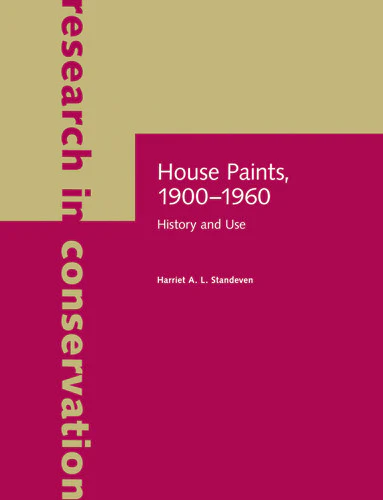
House Paints, 1900-1960: History and Use
Harriet A. L. Standeven
The versatility of modern commercial house paints has ensured their use in a broad range of applications, including the protection and decoration of historic buildings, the coating of toys and furniture, and the creation of works of art. Historically, house paints were based on naturally occurring oils, gums, resins, and proteins, but in the early twentieth century, the introduction of synthetic resins revolutionized the industry. Good quality ready-mixed products became available and were used by artists worldwide.
While the ubiquity of commercial paints means that conservators are increasingly called upon to preserve them, such paints pose unique challenges including establishing exactly which materials are present.
This book traces the history of the household paint industry in the United States and United Kingdom over the first half of the twentieth century. It includes chapters on the artistic use of commercial paints and the development of ready-mixed paints and synthetic resins; oil paints, oleoresinous gloss and enamel paints, water paints, nitrocellulose lacquers, oil-modified alkyds, and emulsion paints; and the conservation implications of these materials. The book will be of interest to conservators and conservation scientists working on a broad range of painted surfaces, as well as curators, art historians, and historians of architectural paint.
Harriet A.L. Standeven is a freelance conservator specializing in the care of modern and contemporary art.
“It is a brave person who attempt to tackle the subject of twentieth-century household paints and Harriet Standeven has done a magnificent job. . . . I am not aware of any other work that covers the same ground.”
—Journal of Architectural Conservation
176 pages
8 1/2 x 11 inches
11 color and 8 b/w illustrations
ISBN 978-1-60606-067-4
paperback
Getty Publications
Imprint: Getty Conservation Institute
Series: Research in Conservation
2011
Product Information
Product Information
Shipping & Returns
Shipping & Returns
Description
Harriet A. L. Standeven
The versatility of modern commercial house paints has ensured their use in a broad range of applications, including the protection and decoration of historic buildings, the coating of toys and furniture, and the creation of works of art. Historically, house paints were based on naturally occurring oils, gums, resins, and proteins, but in the early twentieth century, the introduction of synthetic resins revolutionized the industry. Good quality ready-mixed products became available and were used by artists worldwide.
While the ubiquity of commercial paints means that conservators are increasingly called upon to preserve them, such paints pose unique challenges including establishing exactly which materials are present.
This book traces the history of the household paint industry in the United States and United Kingdom over the first half of the twentieth century. It includes chapters on the artistic use of commercial paints and the development of ready-mixed paints and synthetic resins; oil paints, oleoresinous gloss and enamel paints, water paints, nitrocellulose lacquers, oil-modified alkyds, and emulsion paints; and the conservation implications of these materials. The book will be of interest to conservators and conservation scientists working on a broad range of painted surfaces, as well as curators, art historians, and historians of architectural paint.
Harriet A.L. Standeven is a freelance conservator specializing in the care of modern and contemporary art.
“It is a brave person who attempt to tackle the subject of twentieth-century household paints and Harriet Standeven has done a magnificent job. . . . I am not aware of any other work that covers the same ground.”
—Journal of Architectural Conservation
176 pages
8 1/2 x 11 inches
11 color and 8 b/w illustrations
ISBN 978-1-60606-067-4
paperback
Getty Publications
Imprint: Getty Conservation Institute
Series: Research in Conservation
2011